

Smart home technology can bring lighting, climate, entertainment and access controls into a coordinated interior. For an Istanbul penthouse, coastal villa or commercial property, the value lies in choosing useful functions and integrating them with the architecture. It is an option to evaluate against your needs, maintenance plans and budget rather than a requirement for every luxury home.
The living rooms, bedrooms and study in Dahlan Villa provide a room-by-room reference for preparing a lighting and control brief. The portfolio documents interior proposals; it does not establish that a particular smart-home system was installed or commissioned.
Smart home technology for luxury interiors: Why it matters in 2026
Property owners and developers increasingly consider connected controls as part of interior planning. Their usefulness depends on usability, compatibility, maintenance and how occupants live. Assess convenience and energy management separately from any expectation of a higher property price.
Lighting schedules, responsive climate controls and coordinated security functions can support daily routines. There is no universal percentage by which a smart system raises property value. The design should focus on the occupants’ actual preferences, reliable operation and clear manual controls.
At AA-DO Design Studio, we work with property owners and investors across Istanbul to embed smart technology seamlessly into architectural and interior design projects from the very first planning stage. Planning technology early helps the team coordinate equipment, access and controls with the interior proposal.
Core systems every luxury smart home needs
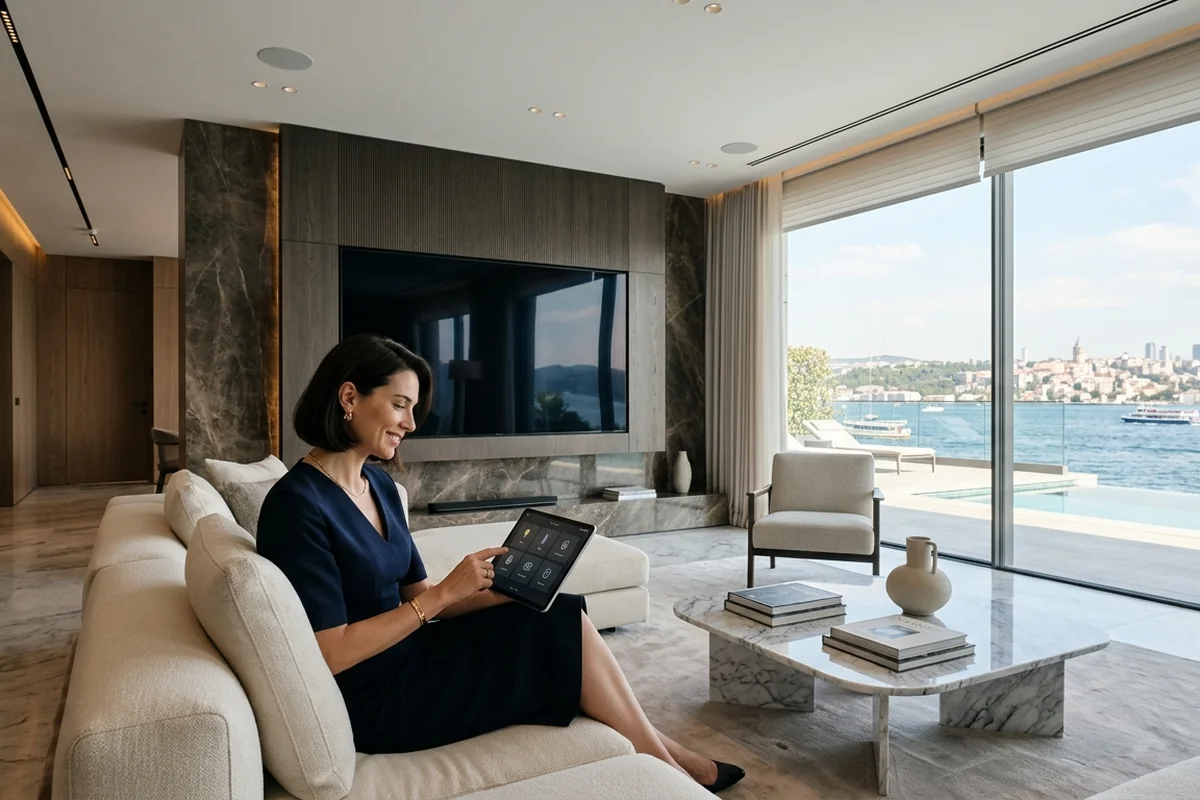
Building a truly intelligent luxury interior requires more than installing a few smart bulbs. You need a cohesive ecosystem of interconnected systems, each designed to complement the aesthetic and functional goals of the space. Here are the foundational pillars every luxury smart home should include:
- Intelligent lighting control: Suitable products can adjust brightness and, where supported, colour temperature to suit activities and schedules. Confirm the specified luminaires and controls are compatible; lighting automation alone is not a health guarantee.
- Advanced climate management: Multi-zone HVAC systems with AI-driven thermostats learn occupant behavior and optimize energy use without sacrificing comfort.
- Whole-home audio and visual integration: Distributed audio systems and motorized projection screens disappear into walls and ceilings, preserving the clean lines of luxury interiors.
- Smart security and access control: Locks, cameras and access systems should be selected with privacy, cybersecurity, reliability and emergency access in mind. No connected system is impenetrable.
- Automated window treatments: Motorized blinds and curtains respond to sunlight levels, protecting furnishings and maintaining privacy at the touch of a button.
- Energy management systems: Real-time monitoring of energy consumption allows owners to optimize usage and reduce costs significantly.
Resources from the U.S. Department of Energy can inform energy-management choices. Actual savings depend on equipment, settings, climate and occupant behaviour; a fixed saving percentage should not be assumed.
The key to success lies in selecting systems that integrate through a single, unified platform. A fragmented ecosystem creates friction — the opposite of what luxury living demands.
10 expert tips for integrating smart technology into luxury interiors
Integrating smart technology beautifully requires strategic thinking from the earliest design stages. These ten expert tips will help you achieve a result that is both technically powerful and visually flawless.
1. Plan infrastructure before walls close. Conduit pathways, data cabling, and power provisions must be mapped during the architectural phase. Retrofitting is costly and disruptive. Our team at Steps in Project Planning and Execution outlines exactly how early coordination prevents expensive rework.
2. Choose a coordinated integration platform. Control4, Crestron and Savant are examples of systems that can bring supported devices into a common interface. Verify compatibility for every proposed device and function; a shared platform does not automatically remove integration problems.
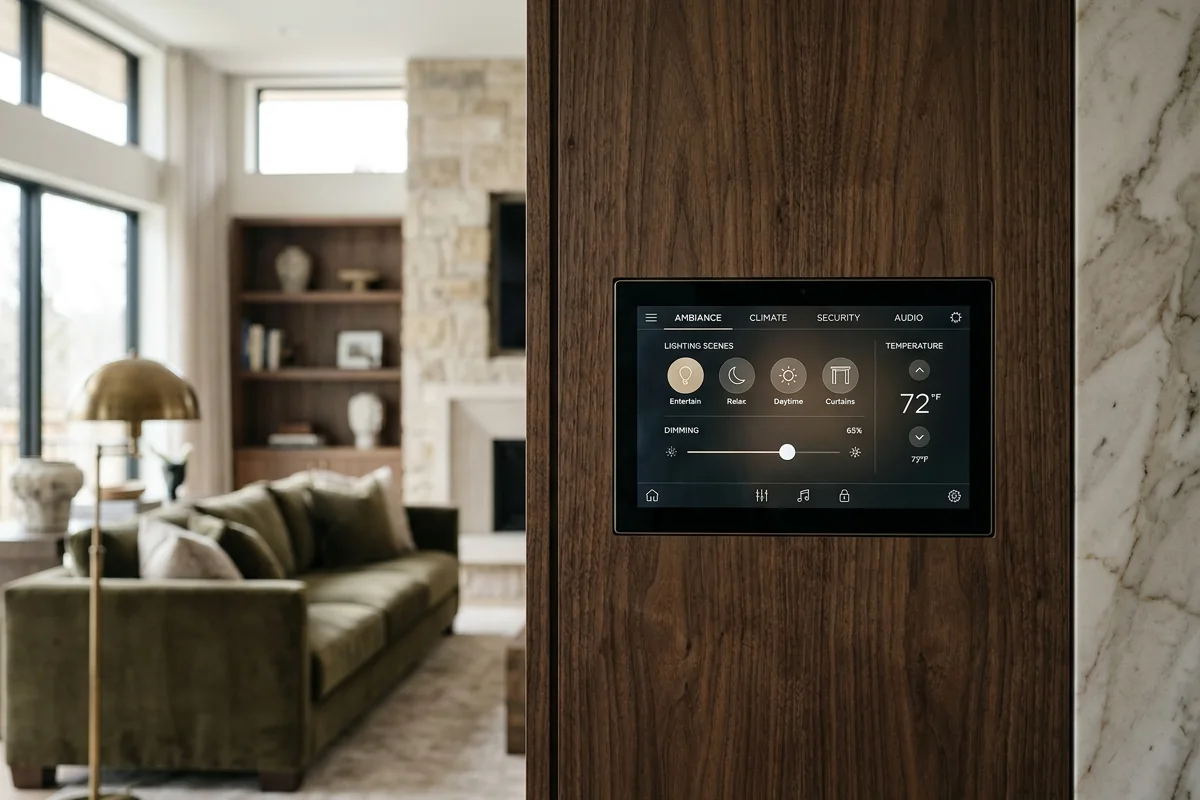
3. Conceal technology within design elements. Speakers should disappear into ceilings. Touchscreens should flush-mount into walls. Control panels should match the material palette of the room — whether that is brushed brass, matte stone, or lacquered wood.
4. Prioritize cybersecurity from day one. Luxury homes are high-value targets for digital intrusion. Use enterprise-grade network architecture, segment IoT devices onto separate VLANs, and work with certified smart home integrators.
5. Invest in professional commissioning. A system is only as good as its programming. Professional commissioning should test scenes, schedules and automations against the agreed user requirements and record any adjustments.
6. Design for future scalability. Technology evolves rapidly. Specify open-protocol systems and leave spare conduit capacity so the home can accommodate new devices without major disruption.
7. Consider comfort and indoor-environment monitoring. Adjustable lighting, air-quality sensors and suitable water controls can support informed operation. Their effect depends on specifications, maintenance and occupant needs; avoid unsupported health claims.
8. Use 3D visualization to preview technology integration. Before installation, visualize how control panels, screens, and speaker grilles will look within the finished interior. Learn more about the benefits of 3D visualization in architecture to understand how this step prevents costly design mistakes.
9. Train occupants and provide intuitive interfaces. Even the most sophisticated system fails if users find it confusing. Invest in proper training and design interfaces that feel natural and effortless.
10. Work with an integrated design and technology team. The best results come when architects, interior designers, and smart home integrators collaborate from day one — not when technology is bolted on after construction.
Here is a quick checklist of what to confirm before your smart home installation begins:
- Structural and MEP drawings updated with technology zones
- Network infrastructure designed to enterprise standards
- All device brands and protocols confirmed as compatible
- Integration platform selected and programming scope defined
- Commissioning schedule aligned with construction handover
Comparing the top smart home platforms for luxury properties
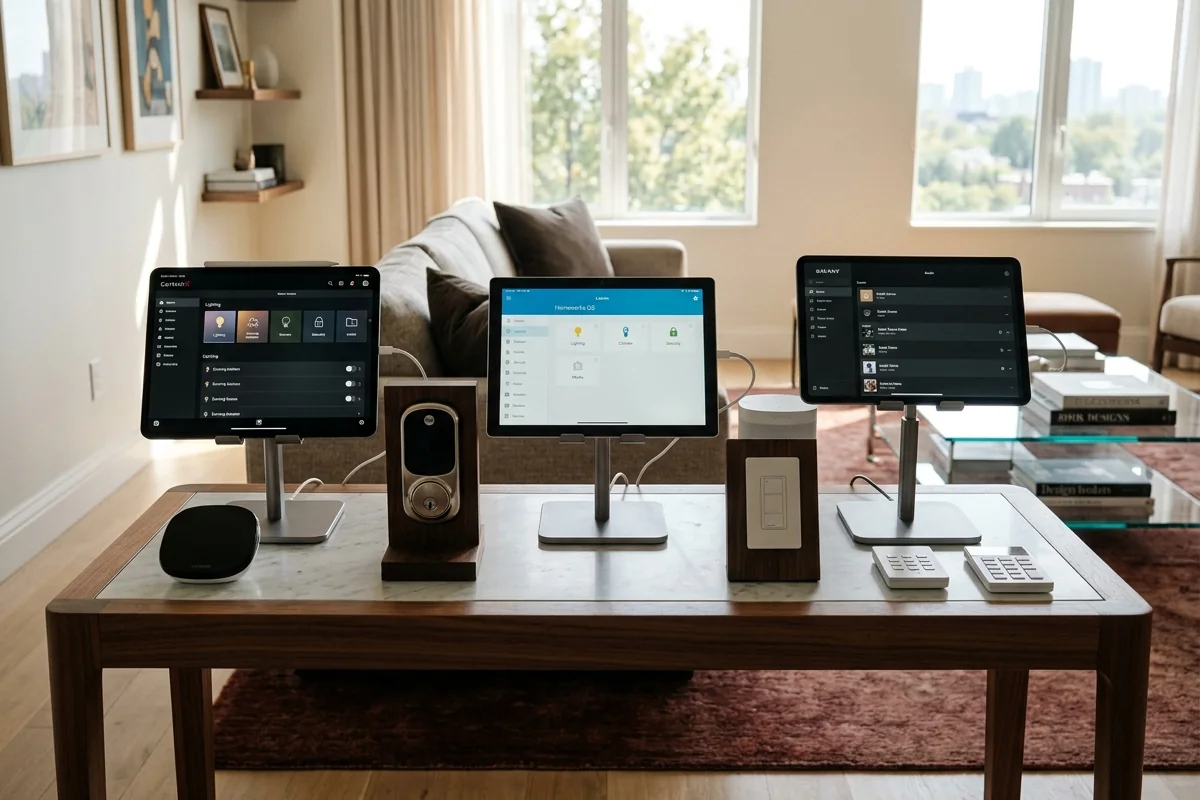
Control platforms differ in supported functions, installation requirements and maintenance. The following five examples provide a starting point for discussion, not a ranking or price quotation. Confirm current regional availability, compatibility and a project-specific installed cost.
| Platform | Best For | Key Strength | Integration Depth | Cost basis |
|---|---|---|---|---|
| Crestron | Ultra-high-end estates and commercial spaces | Configurable home and building control | Verify supported devices and interfaces | Project-specific quotation |
| Control4 | Luxury villas and high-end residences | Coordinated residential control | Supported AV, lighting, climate and security devices | Project-specific quotation |
| Savant | Design-forward luxury homes | App-based control and scene configuration | Supported entertainment, lighting and home systems | Project-specific quotation |
| KNX | European luxury projects and commercial builds | Open standard, vendor-independent | Interoperability requires compatible KNX products and configuration | Project-specific quotation |
| Lutron RadioRA 3 | Lighting-focused luxury projects | Professional lighting and shade control | Verify regional products and supported integrations | Project-specific quotation |
Select the platform around required functions, local integration support, ongoing service, privacy and future changes. Crestron, Control4 and Savant provide proprietary ecosystems; KNX offers a standard used by multiple manufacturers. For Lutron, confirm the exact regional product family and electrical compatibility before specification.
The CEDIA (Custom Electronics Design and Installation Association) provides comprehensive resources and certified professional directories to help property owners identify qualified integrators in their region — a critical step before committing to any platform.
When working on villa architectural design projects in Istanbul, our team consistently recommends early-stage platform selection as a non-negotiable step. The choice of platform shapes cabling strategies, device specifications, and ultimately the quality of the finished experience.
Commercial properties also require attention to scalability, tenant permissions and energy reporting. LEED certification guidance from the U.S. Green Building Council can inform project assessment, but installing smart controls does not itself establish certification or guarantee credits.
A successful system should balance comfort, security, energy management and appearance. Define measurable operating requirements and assess the complete experience, including outages, manual overrides and maintenance.
If you are planning a new build, renovation, or commercial fit-out and want to understand how smart technology can be woven into your project from the ground up, explore our luxury architectural design services in Istanbul or reach out directly through our contact page to discuss your specific vision with our team.
Frequently Asked Questions
Q1: At what stage of a project should smart home technology be planned?
Smart home technology planning should begin during the architectural design phase — before structural walls are finalized and MEP (mechanical, electrical, and plumbing) drawings are completed. Early planning identifies conduit routes, network infrastructure and power needs for coordination with the relevant specialists; installation and performance still require checks. The earlier smart technology is integrated into the design process, the more seamless and cost-effective the result.
Q2: Does smart home technology add measurable value to a luxury property?
A well-planned system may improve convenience and help manage energy use, but property-price gains and savings are not guaranteed. Outcomes depend on the equipment, commissioning, usage, support and local market. Compare initial and ongoing costs with the functions that matter to the occupants.
Q3: Can smart home systems be integrated into a renovation project, not just new builds?
Yes. Existing buildings can use a combination of wired and wireless controls, depending on access, construction and system compatibility. Examples include suitable regional Lutron products and Z-Wave devices, subject to verification. An experienced design and integration team should survey cable routes, radio coverage and maintenance access. Do not assume every retrofit will be disruption-free.

Related Posts
High-End Interior Design: 7 Illustrative Scenarios
Explore 7 client success stories in high-end interior design and discover how…

Outdoor Living Spaces for Istanbul’s Climate: 7 Strategies
Discover 7 expert tips for designing outdoor living spaces for Istanbul's…
Creating a Cohesive Home Design: Colours, Materials and Rooms
Master creating a cohesive design theme for your home with 10 expert tips that…