

Istanbul’s unique geography sits at the crossroads of two continents, and its climate reflects that dramatic duality. Designing outdoor living spaces for Istanbul’s climate means balancing hot, dry summers, mild but rainy winters, and the persistent Bosphorus winds that sweep across the city year-round. Whether you own a Bosphorus-view villa, a rooftop apartment terrace, or a commercial courtyard, getting your outdoor design right transforms a neglected exterior into a true extension of your interior life. In this guide, we share seven expert-backed strategies to help you create outdoor spaces that look stunning and perform brilliantly across every season.
The terrace and garden relationships in Tutku Premium Villas and Lavies Şile provide Istanbul residential design references. Compare privacy, access and the connection to indoor rooms, while assessing shade, drainage and weather exposure for the particular site rather than assuming measured climatic performance.
Why Istanbul’s Climate Demands Thoughtful Outdoor living spaces for Istanbul’s climate
Istanbul outdoor spaces must respond to summer sun, seasonal rain, humidity and wind. Conditions differ between coastal, exposed hillside and sheltered urban sites. Use local climate records and a site survey to assess ultraviolet exposure, drainage and weathering instead of relying on one city-wide average.
Poor outdoor design in Istanbul leads to cracked stone paving, rusting metalwork, waterlogged planters, and furniture that deteriorates within two seasons. These are expensive mistakes that many property owners make simply because they apply generic Mediterranean or Northern European design principles without adapting them to Istanbul’s specific microclimate. Working with specialists who understand local conditions is essential — you can explore how villa architectural design in Istanbul addresses these challenges at a structural level.
At AA-DO, outdoor planning considers sun angles, wind exposure including the northeasterly Poyraz, and drainage before furniture or planting. Long-term performance also depends on detailing, installation, maintenance and the actual site conditions.
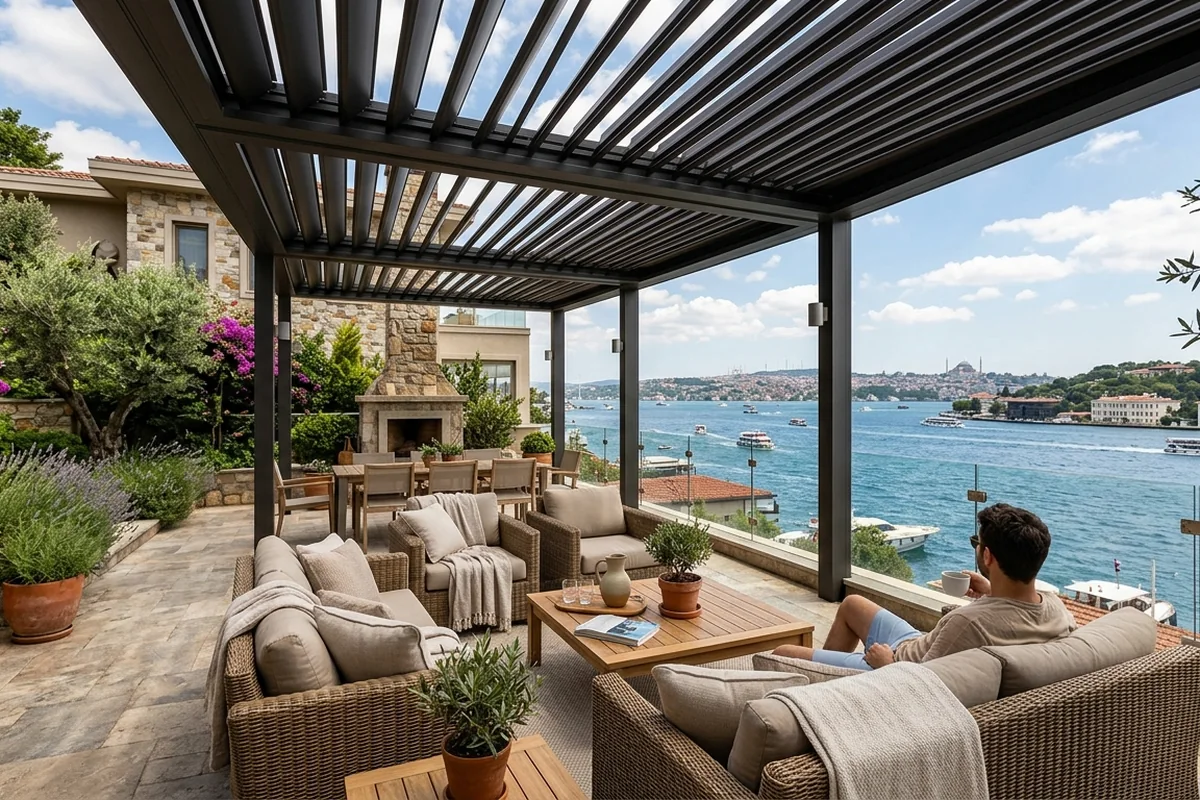
Understanding Istanbul’s Four-Season Climate Challenges
Before selecting materials, furniture or planting, assess the site’s seasonal exposure. Istanbul has varied local conditions, and coastal or elevated properties can behave differently from sheltered courtyards. Account for sun, rain, humidity, wind and occasional freezing conditions.
Here are the key climate forces shaping outdoor design decisions in Istanbul:
- Summer: Assess strong sunlight, heat and humidity, which can affect untreated timber, finishes and textiles.
- Autumn: Plan for rainfall and wind exposure, with drainage inspected before wetter periods.
- Winter: Allow for rain, occasional snow and freeze-thaw exposure where relevant; specify materials suitable for those conditions.
- Spring (March–May): Rapid temperature swings between day and night. Thermal expansion and contraction stress paving joints and structural connections.
ArchDaily’s outdoor-space design coverage offers examples of climate-responsive architecture. Use them as references while checking durability and usability against the conditions of your particular Istanbul site.
Understanding these seasonal patterns lets you make informed choices about shading systems, drainage slopes, material porosity, and plant selection. It also helps you prioritize your budget — investing more in waterproofing and wind protection often delivers a higher return than spending on decorative elements that won’t survive the first winter.
7 Expert Design Strategies for Outdoor Living Spaces in Istanbul
Now we get to the practical core of this guide. These seven strategies come directly from our experience designing outdoor living spaces for Istanbul’s climate across residential villas, commercial rooftops, and mixed-use courtyards.
1. Design for Wind First
Assess prevailing winds, exposure and structural loads before choosing screens, evergreen planting or glass barriers. A suitable engineer should design and verify exposed barriers, guards and pergolas, including anchorage; appearance alone is not a basis for specification.
2. Layer Your Shading System
A single fixed pergola is rarely enough. Combine a structural pergola with retractable fabric awnings and adjustable louvered roofs. This layering lets you fine-tune sun and rain protection throughout the day and across seasons.
3. Build in Year-Round Heating
Suitable outdoor heaters may extend comfortable use in cooler weather. Select equipment rated for its location and follow the manufacturer’s installation, clearance and ventilation requirements. Any fire feature needs a separate assessment of fire safety and local permissions; it is not an automatic companion to a heater.
4. Prioritize Drainage Engineering
Design falls, outlets, overflows and waterproofing as a coordinated system. The appropriate gradient and drainage capacity depend on the surface, assembly, rainfall design criteria and manufacturer’s requirements. Have these specified for the project rather than applying one percentage to every terrace.
5. Choose Frost-Resistant, UV-Stable Materials
Consider external-grade porcelain, suitably protected aluminium and durable timber such as teak or iroko where appropriate. Verify frost resistance, wet slip performance, ultraviolet durability, sourcing and maintenance for the exact product and application.
6. Integrate Smart Outdoor Lighting
Specify luminaires and electrical installation for the actual exposure, including moisture, impact and any immersion risk. IP ratings describe particular protection levels and do not replace a complete installation design. Warm light around 2700–3000K and suitable sensors can support ambience and circulation while limiting glare.
7. Select Climate-Adapted Planting
Select planting for the site’s sun, wind, soil, irrigation and frost exposure. Olive, lavender, rosemary, agapanthus and ornamental grasses are options to assess with a landscape specialist; suitability varies by species and microclimate.
For projects where the outdoor space connects directly to a renovated interior, our team coordinates both scopes simultaneously. See how our residential renovation architects in Istanbul integrate indoor-outdoor design from the earliest planning stages.
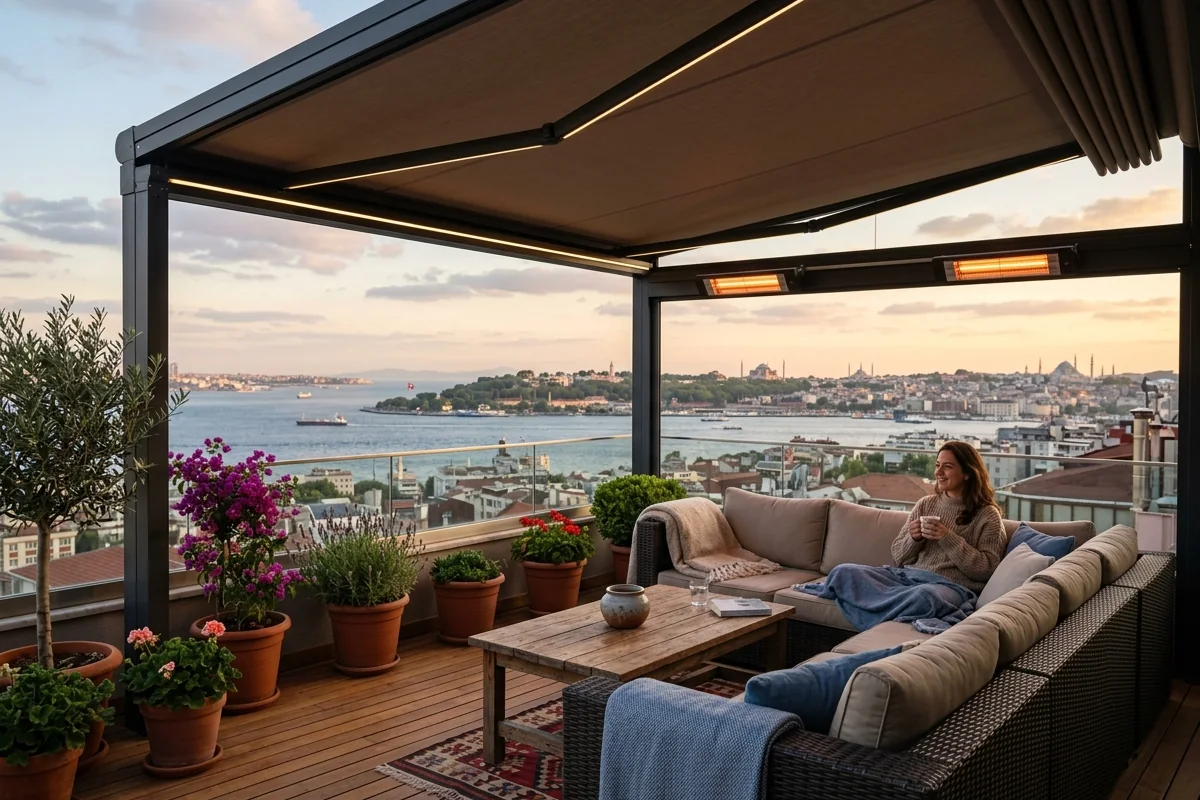
Material Selection and Sustainability for Istanbul Outdoor Spaces
Choosing the right materials is arguably the single most impactful decision you make when designing outdoor living spaces for Istanbul’s climate. The wrong material choice creates ongoing maintenance costs, safety hazards, and premature replacement expenses that dwarf the original savings.
We consistently recommend the following material categories for Istanbul outdoor projects:
- Paving: Select external-grade surfaces with verified wet slip resistance, suitable joints and drainage. Large porcelain formats are one option, but size and finish must suit the site; polished surfaces need particular scrutiny when wet.
- Structure: Hot-dip galvanized steel or powder-coated aluminum for pergola frames and railings. Both resist Istanbul’s coastal-adjacent humidity far better than untreated steel.
- Furniture: Teak, iroko, or recycled HDPE lumber for seating and tables. All-weather wicker woven over aluminum frames performs well and requires minimal seasonal storage.
- Planting: Specify root volume, growing-medium depth, drainage and irrigation for each plant and planter. Account for saturated weight on roofs; a single minimum depth cannot suit every species.
- Waterproofing: Select a complete roof-terrace waterproofing system compatible with the substrate, movements, outlets and finishes. Polyurethane and PMMA liquid systems are possible options, not universal requirements. Follow the chosen system’s specification and testing procedure.
The U.S. Green Building Council’s LEED framework is one reference for assessing environmental performance. Material durability, embodied impacts, sourcing and end-of-life options should be considered together. A few material choices alone do not establish certification or guarantee a property-value increase.
Proper project planning also determines how smoothly material procurement and installation proceed. We follow a disciplined process that you can read about in detail in our article on steps in project planning and execution.
Illustrative Outdoor Design Scenarios for Istanbul
Theory becomes meaningful when you see it applied. Here we compare four common Istanbul property types and the outdoor design approaches that work best for each.
| Property Type | Primary Challenge | Recommended Approach | Key Material |
|---|---|---|---|
| Bosphorus-view villa terrace | Northeast Poyraz wind + salt-laden air | Engineered wind screens and a suitable pergola | Marine-grade aluminum, teak decking |
| Rooftop apartment terrace | Waterproofing, weight loading limits | Weight-checked decking, drainage and container planting | HDPE lumber, porcelain tiles |
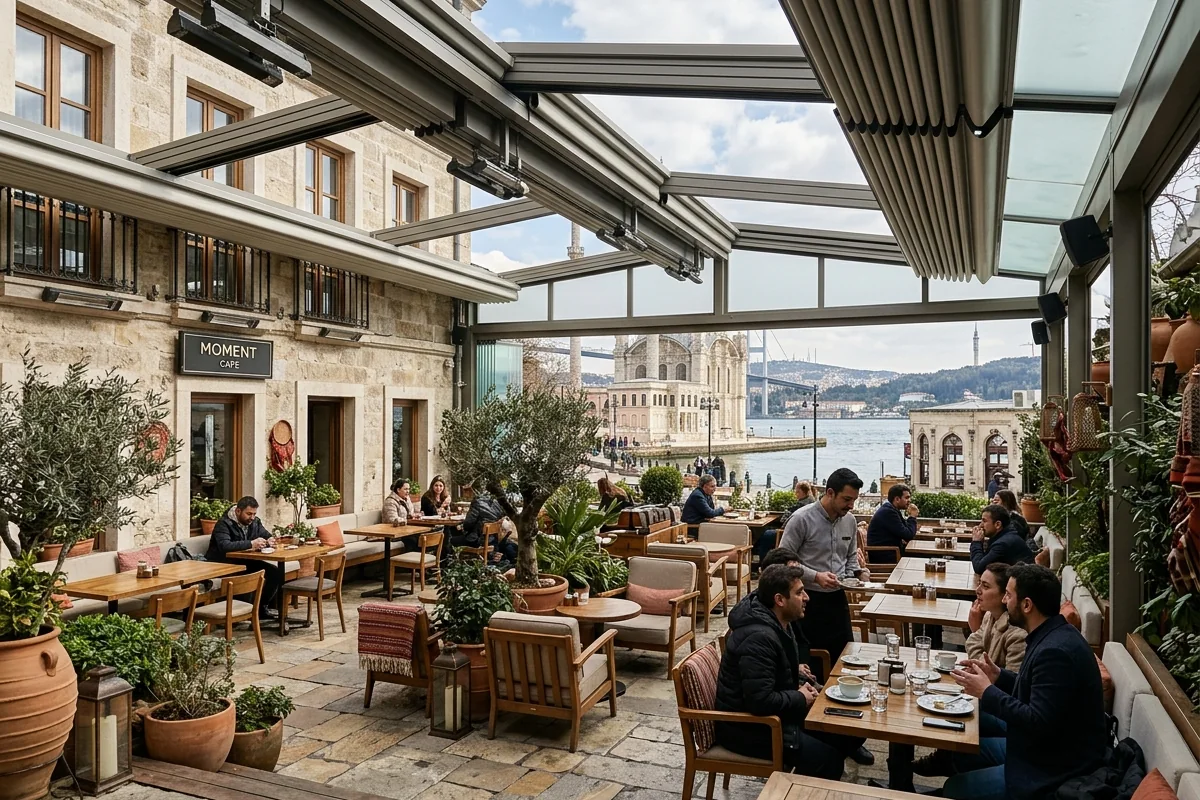
| Commercial restaurant courtyard | Year-round usability, heavy foot traffic | Suitable roof, heating and wet-slip-resistant paving | Powder-coated steel, anti-slip porcelain |
| Suburban villa garden | Drainage, frost protection, privacy | Graded lawn with French drains, evergreen hedging, pergola zone | Natural stone edging, iroko timber |
Each scenario has different priorities. An exposed villa terrace may justify more durable finishes and wind protection, while a family garden may emphasise low-maintenance planting and safe circulation. Allocate spending to the actual use and site risks rather than assuming a rental return.
Examples in Dezeen’s architecture and design coverage can help explore outdoor life in dense cities. Evaluate comfort, access, maintenance and climate response for your own project rather than assuming a particular financial benefit.
For commercial property owners considering outdoor hospitality or retail spaces, the structural and regulatory dimensions add another layer of complexity. Our team handles these comprehensively — visit our contact page to discuss your specific project requirements with our design team.
Outdoor spaces may influence a buyer’s preferences, but their effect on price depends on location, condition, market and design. If consulting research on urban outdoor space and property values, check the study’s setting and methods before applying its findings to an Istanbul property. No general resale premium can be promised.
Frequently Asked Questions
Q1: What is the best season to start an outdoor living space project in Istanbul?
Choose the construction window around weather forecasts, site access and the specified materials. Spring can be convenient, but adhesives, coatings and waterproofing each have temperature, moisture and curing limits. Plan protected working conditions where needed rather than relying solely on a calendar month.
Q2: How much does it cost to design and build an outdoor living space in Istanbul?
Costs depend on area, structural work, access, waterproofing, drainage, finishes, lighting and planting. Obtain an itemised quotation after a site survey and compare installation and maintenance costs over time. No single square-metre rate or maintenance-saving percentage applies to every terrace.
Q3: Do I need an architect or interior designer for an outdoor living space project in Istanbul?
For alterations beyond loose furniture, involve the relevant design specialists. Rooftop loads, pergolas, guards, waterproofing and changes to the exterior may need engineering checks and permissions depending on the project. Confirm requirements with the responsible professionals and local authority. Learn about our approach on the About page.

Related Posts
High-End Interior Design: 7 Illustrative Scenarios
Explore 7 client success stories in high-end interior design and discover how…

Smart Home Technology for Luxury Interiors: 10 Tips
Discover how smart home technology for luxury interiors elevates comfort,…
Creating a Cohesive Home Design: Colours, Materials and Rooms
Master creating a cohesive design theme for your home with 10 expert tips that…