

Istanbul’s unique geography sits at the crossroads of two continents, and its climate reflects that dramatic duality. Designing outdoor living spaces for Istanbul’s climate means balancing hot, dry summers, mild but rainy winters, and the persistent Bosphorus winds that sweep across the city year-round. Whether you own a Bosphorus-view villa, a rooftop apartment terrace, or a commercial courtyard, getting your outdoor design right transforms a neglected exterior into a true extension of your interior life. In this guide, we share seven expert-backed strategies to help you create outdoor spaces that look stunning and perform brilliantly across every season.
Table of contents
- Why Istanbul’s Climate Demands Thoughtful Outdoor living spaces for Istanbul’s climate
- Understanding Istanbul’s Four-Season Climate Challenges
- 7 Expert Design Strategies for Outdoor Living Spaces in Istanbul
- Material Selection and Sustainability for Istanbul Outdoor Spaces
- Real-World Examples: Outdoor Living Spaces That Work in Istanbul
- Frequently Asked Questions
Why Istanbul’s Climate Demands Thoughtful Outdoor living spaces for Istanbul’s climate
Istanbul receives an average of 2,600 hours of sunshine per year, yet it also records around 840 mm of annual rainfall — most of it concentrated between October and March. This combination creates a demanding environment for any outdoor design. Surfaces must handle intense UV exposure in July and standing water in January, often within the same six-month window.
Poor outdoor design in Istanbul leads to cracked stone paving, rusting metalwork, waterlogged planters, and furniture that deteriorates within two seasons. These are expensive mistakes that many property owners make simply because they apply generic Mediterranean or Northern European design principles without adapting them to Istanbul’s specific microclimate. Working with specialists who understand local conditions is essential — you can explore how villa architectural design in Istanbul addresses these challenges at a structural level.
At AA-DO, we approach every outdoor project through a climate-first lens. We analyze sun angles, prevailing wind directions from the northeast (the famous Poyraz wind), and drainage gradients before we place a single piece of furniture or plant a single tree. This methodology ensures your outdoor space remains beautiful and functional for decades, not just seasons.
Understanding Istanbul’s Four-Season Climate Challenges
Before you invest in materials, furniture, or landscaping, you need to understand exactly what Istanbul’s climate will throw at your outdoor space. The city experiences a transitional climate between oceanic and humid subtropical, which means no two seasons are predictable in the same way.
Here are the key climate forces shaping outdoor design decisions in Istanbul:
- **Summer (June–August):** Temperatures regularly reach 32–36°C. UV radiation is intense. The Bosphorus creates localized humidity that accelerates the degradation of untreated wood and certain fabrics.
- **Autumn (September–November):** Mild temperatures but increasing rainfall. Wind speeds rise sharply in October. This is when drainage failures become immediately visible.
- **Winter (December–February):** Temperatures drop to 3–7°C on average, with occasional snow. Frost can crack unglazed ceramics and poorly sealed natural stone.
- **Spring (March–May):** Rapid temperature swings between day and night. Thermal expansion and contraction stress paving joints and structural connections.
According to ArchDaily’s coverage of outdoor space design, climate-responsive architecture consistently outperforms generic design in long-term durability and occupant satisfaction. Istanbul’s complexity makes this principle even more critical than in more stable climates.
Understanding these seasonal patterns lets you make informed choices about shading systems, drainage slopes, material porosity, and plant selection. It also helps you prioritize your budget — investing more in waterproofing and wind protection often delivers a higher return than spending on decorative elements that won’t survive the first winter.
7 Expert Design Strategies for Outdoor Living Spaces in Istanbul
Now we get to the practical core of this guide. These seven strategies come directly from our experience designing outdoor living spaces for Istanbul’s climate across residential villas, commercial rooftops, and mixed-use courtyards.
1. Design for Wind First
The Poyraz wind from the northeast can reach 60–80 km/h during autumn and winter. Install perforated windbreak screens, dense evergreen hedging, or frameless glass balustrades that deflect wind without blocking views.
2. Layer Your Shading System
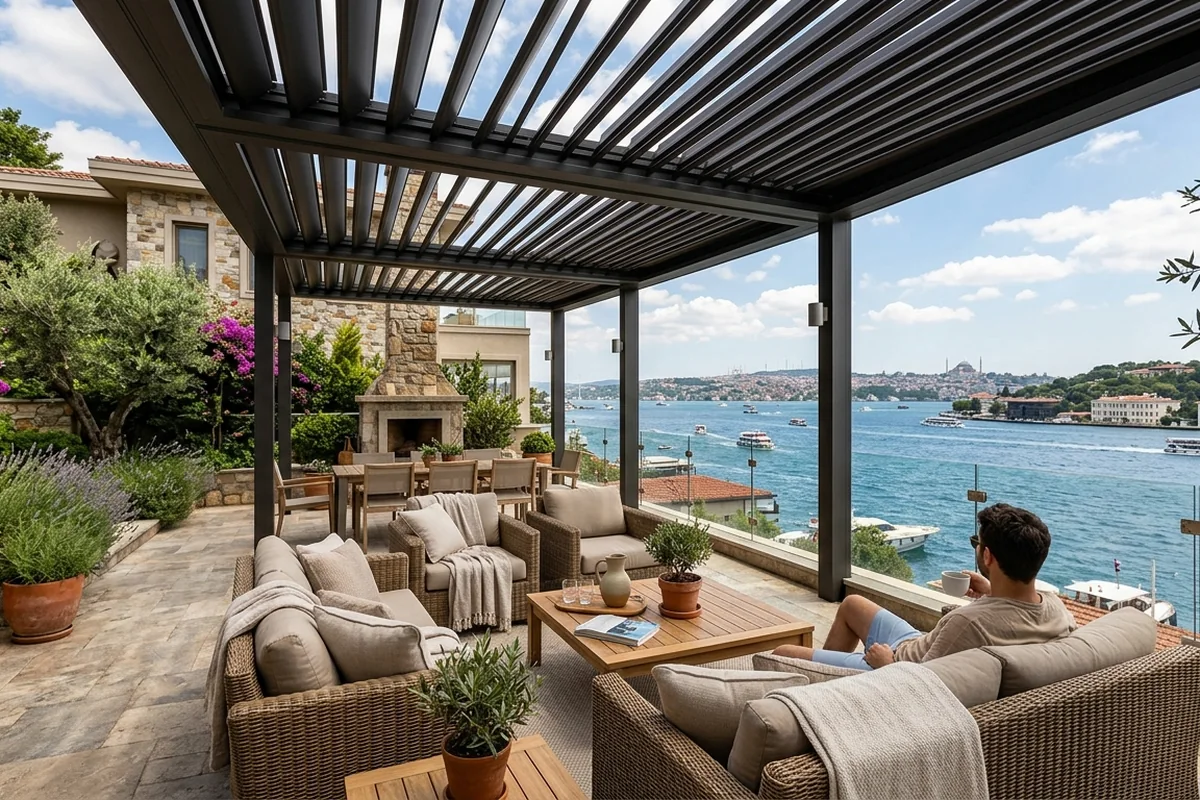
A single fixed pergola is rarely enough. Combine a structural pergola with retractable fabric awnings and adjustable louvered roofs. This layering lets you fine-tune sun and rain protection throughout the day and across seasons.
3. Build in Year-Round Heating
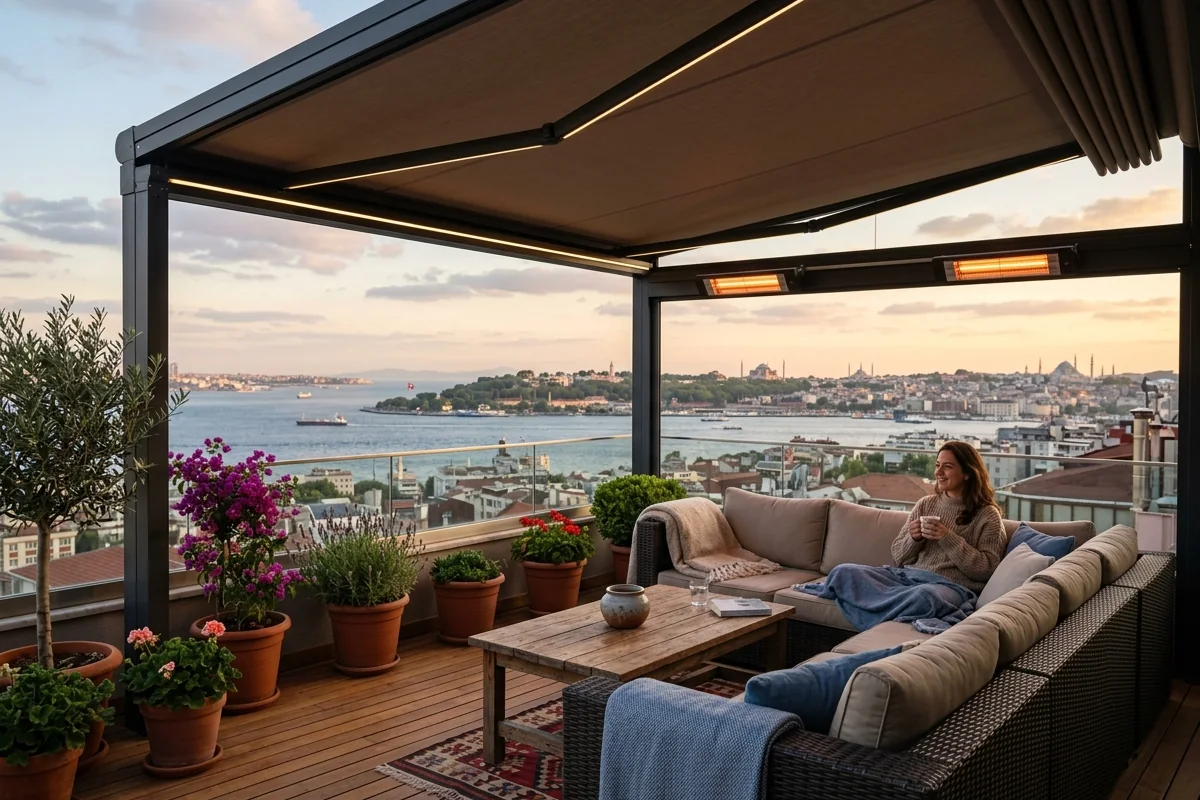
Outdoor infrared heaters mounted overhead extend your usable outdoor season by at least four months. Pair them with a fire pit or bioethanol fireplace as a focal point that also provides radiant warmth.
4. Prioritize Drainage Engineering
Slope all hard surfaces at a minimum 1.5% gradient toward concealed linear drains. Istanbul’s winter rainfall events can be sudden and heavy — inadequate drainage turns terraces into pools within minutes.
5. Choose Frost-Resistant, UV-Stable Materials
Porcelain stoneware tiles rated for external use (slip resistance R11 or higher), powder-coated aluminum frames, and teak or iroko hardwood are proven performers in Istanbul’s climate range.
6. Integrate Smart Outdoor Lighting
LED systems with IP65 or IP67 waterproof ratings handle Istanbul’s rain reliably. Use warm white tones (2700–3000K) to create evening ambience, and install motion sensors for security around the perimeter.
7. Select Climate-Adapted Planting
Choose plants that tolerate both summer drought and winter frost. Olive trees, lavender, rosemary, agapanthus, and ornamental grasses thrive in Istanbul’s conditions without excessive maintenance.
For projects where the outdoor space connects directly to a renovated interior, our team coordinates both scopes simultaneously. See how our residential renovation architects in Istanbul integrate indoor-outdoor design from the earliest planning stages.
Material Selection and Sustainability for Istanbul Outdoor Spaces
Choosing the right materials is arguably the single most impactful decision you make when designing outdoor living spaces for Istanbul’s climate. The wrong material choice creates ongoing maintenance costs, safety hazards, and premature replacement expenses that dwarf the original savings.
We consistently recommend the following material categories for Istanbul outdoor projects:
- **Paving:** Large-format porcelain tiles (60×120 cm or larger) with R11 anti-slip rating. Avoid polished natural stone on horizontal surfaces — it becomes dangerously slippery when wet.
- **Structure:** Hot-dip galvanized steel or powder-coated aluminum for pergola frames and railings. Both resist Istanbul’s coastal-adjacent humidity far better than untreated steel.
- **Furniture:** Teak, iroko, or recycled HDPE lumber for seating and tables. All-weather wicker woven over aluminum frames performs well and requires minimal seasonal storage.
- **Soft landscaping:** Use a minimum 300mm depth of quality growing medium in raised planters to buffer against both summer heat and winter frost at root level.
- **Waterproofing membranes:** For rooftop terraces, apply a polyurethane or PMMA liquid waterproofing system beneath all finishes. This is non-negotiable in Istanbul’s rainfall context.
Sustainability matters beyond durability. The U.S. Green Building Council’s LEED framework provides internationally recognized benchmarks for sustainable outdoor material selection, including embodied carbon, recyclability, and regional sourcing criteria. Applying these principles to your Istanbul outdoor project reduces environmental impact and often qualifies the property for green certification that adds measurable market value.
Proper project planning also determines how smoothly material procurement and installation proceed. We follow a disciplined process that you can read about in detail in our article on steps in project planning and execution.
Real-World Examples: Outdoor Living Spaces That Work in Istanbul
Theory becomes meaningful when you see it applied. Here we compare four common Istanbul property types and the outdoor design approaches that work best for each.
| Property Type | Primary Challenge | Recommended Approach | Key Material |
|---|---|---|---|
| Bosphorus-view villa terrace | Northeast Poyraz wind + salt-laden air | Frameless glass wind barriers, louvered pergola | Marine-grade aluminum, teak decking |
| Rooftop apartment terrace | Waterproofing, weight loading limits | Lightweight HDPE decking over drainage mat, container planting | HDPE lumber, porcelain tiles |
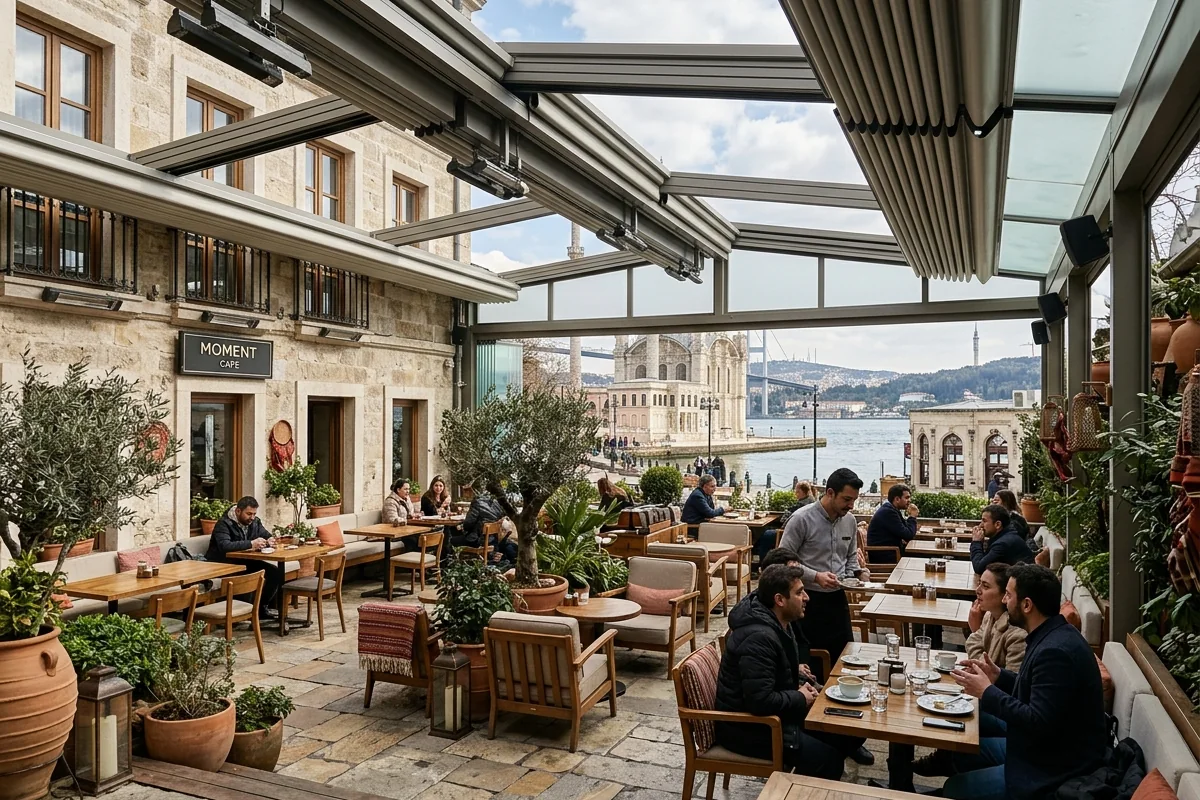
| Commercial restaurant courtyard | Year-round usability, heavy foot traffic | Retractable roof system, infrared heating, R11 paving | Powder-coated steel, anti-slip porcelain |
| Suburban villa garden | Drainage, frost protection, privacy | Graded lawn with French drains, evergreen hedging, pergola zone | Natural stone edging, iroko timber |
Each of these scenarios demands a different balance of investment. A Bosphorus-view villa terrace, for example, justifies premium materials because the outdoor space directly contributes to the property’s market positioning and rental yield. A suburban family garden may prioritize low-maintenance planting and safe paving over high-end finishes.
Research published by Dezeen’s architecture and design editorial team consistently highlights how outdoor spaces in dense urban environments — exactly like Istanbul — deliver disproportionate quality-of-life benefits when designed with genuine climate intelligence. This is not a luxury consideration; it is a functional and financial one.
For commercial property owners considering outdoor hospitality or retail spaces, the structural and regulatory dimensions add another layer of complexity. Our team handles these comprehensively — visit our contact page to discuss your specific project requirements with our design team.
The investment in expert outdoor design also compounds over time. Properties with well-designed outdoor living areas consistently command higher sale prices and rental premiums in Istanbul’s competitive real estate market. According to data from ScienceDirect research on urban outdoor space and property values, quality outdoor environments increase residential property values by 5–15% depending on location and design quality — a significant return on a relatively contained investment.
Frequently Asked Questions
Q1: What is the best season to start an outdoor living space project in Istanbul?
Spring (March to May) is the ideal time to begin construction and installation. Temperatures are mild enough for adhesives and sealants to cure correctly, rainfall is moderate rather than intense, and you position yourself to enjoy the completed space through the full summer season. Avoid starting major paving or waterproofing work in December or January when frost can compromise material bonding.
Q2: How much does it cost to design and build an outdoor living space in Istanbul?
Costs vary widely depending on scope, materials, and property type. A well-specified rooftop terrace for an Istanbul apartment typically starts around $400–$800 per square meter for design, materials, and installation. A premium Bosphorus-view villa terrace with louvered roofing, built-in kitchen, and custom landscaping can reach $1,500–$3,000 per square meter. Investing in quality materials upfront consistently reduces five-year maintenance costs by 30–50% compared to budget alternatives.
Q3: Do I need an architect or interior designer for an outdoor living space project in Istanbul?
For projects beyond basic furniture placement, yes — especially in Istanbul. Structural pergolas, rooftop terraces, drainage systems, and any work that modifies a building’s exterior envelope require architectural oversight and, in many cases, municipal permits. An experienced design team ensures compliance with Istanbul’s building regulations, coordinates structural engineering where needed, and delivers a result that performs reliably across all four seasons. You can learn more about our full-service approach on our About page.

Related Posts
Client success stories in high-end interior design: 7 Proven Wins
Explore 7 client success stories in high-end interior design and discover how…

Smart home technology for luxury interiors: 10 Expert Tips
Discover how smart home technology for luxury interiors elevates comfort,…
Creating a Cohesive Design Theme for Your Home: 10 Expert Tips
Master creating a cohesive design theme for your home with 10 expert tips that…