

Sustainable interior design in Istanbul can connect comfort, craftsmanship and careful resource use. This guide examines seven principles for villas, workplaces and boutique hospitality, alongside material documentation, feasibility and project planning. The appropriate choices depend on the building and its users.
The stone, timber and metal composition of AF Villa offers a material-design reference. Its appearance alone does not establish sustainable sourcing or lifecycle performance; assess any comparable specification using product documentation, durability and maintenance requirements.
Table of contents
- Sustainable luxury: Eco-friendly interior design in Istanbul — What it really means
- 7 Core principles of eco-friendly luxury interiors
- Materials, certifications, and smart sourcing in Istanbul
- Comparing green design approaches: A practical overview
- Frequently Asked Questions
Sustainable luxury: Eco-friendly interior design in Istanbul — What it really means
Sustainable luxury combines considered materials, systems and spatial planning with a comfortable, durable interior. Environmental impact should be assessed across sourcing, construction, operation, maintenance and eventual reuse rather than inferred from appearance alone.
Istanbul’s climate, orientation and existing building conditions influence ventilation, shading and thermal design. Insulation, natural ventilation and passive cooling need project-specific assessment. Structural and seismic safety require their own technical evaluation and cannot be established by interior finishes or environmental measures.
An environmental brief can be discussed with AA Architecture at the concept stage. Set priorities for comfort, energy, water and materials and agree which assessments and deliverables are included. Review the published project portfolio when discussing the desired design direction.
7 Core principles of eco-friendly luxury interiors
The following seven principles provide a starting point. Their suitability and expected performance should be assessed for the actual property rather than applied as a universal checklist.
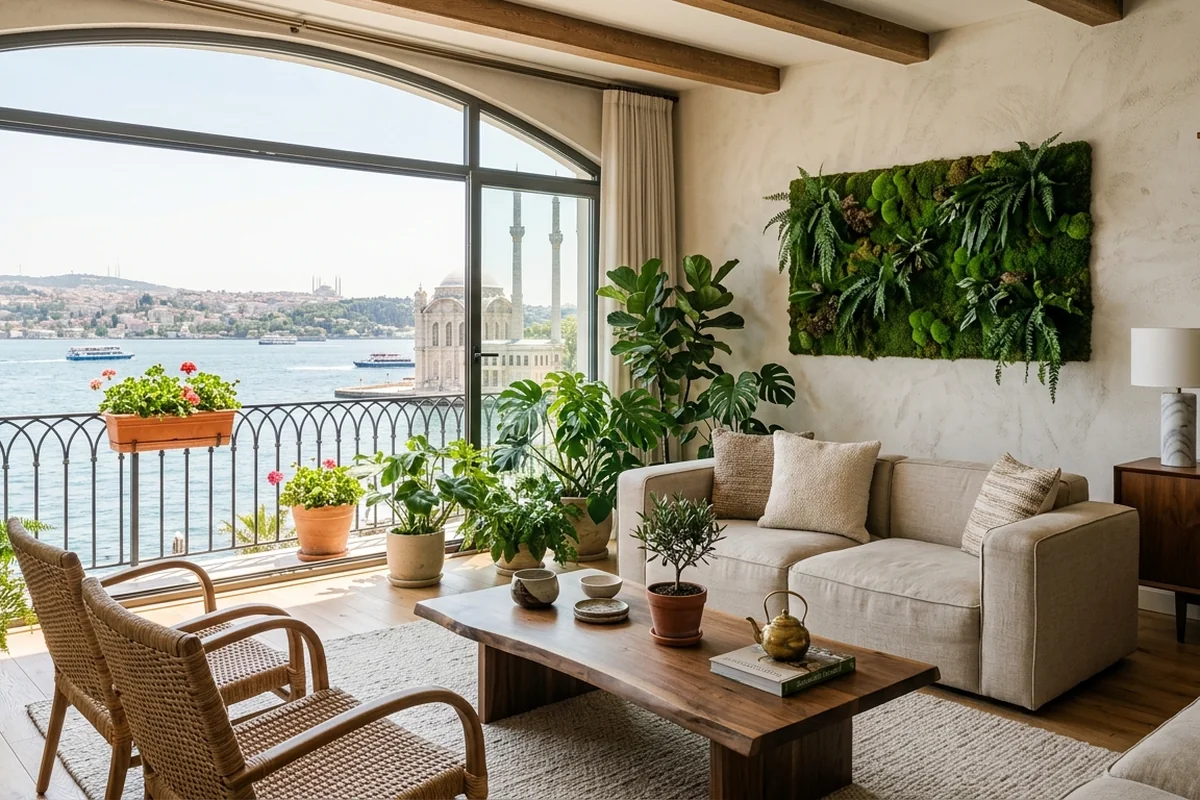
- Nature and daylight: Consider daylight, plants and natural materials alongside glare, ventilation and maintenance. Select planting for available light and care; visual greenery alone does not demonstrate a health outcome.
- Insulation and glazing: Compare thermal performance, solar gain, airtightness and condensation risk. The appropriate glazing and insulation depend on the existing envelope, orientation and technical design; triple glazing is not automatically required.
- Lower-emission finishes: Request emissions documentation for paints, adhesives and sealants. A low-VOC description does not mean a product is harmless in every condition. Follow application, ventilation and curing guidance.
- Water use: Compare documented flow rates and toilet flushing volumes. Greywater reuse needs a suitable technical design, maintenance plan and confirmation of applicable requirements.
- Renewable energy feasibility: Assess solar exposure, roof availability, structural capacity, connections and storage requirements before planning photovoltaics or batteries. Phased installation should be coordinated with the electrical design.
- Retain, repair and reuse: Consider existing furniture, reclaimed wood and recoverable components. Compare sourcing, processing, transport and service life; local or recycled content does not by itself establish lower whole-life impact.
- Controls and monitoring: Occupancy sensors, shading and energy monitoring may support consumption management when correctly commissioned and understood by users. Account for maintenance and system compatibility.
Coordinate the measures: an appropriate envelope can reduce heating and cooling demand, while controls help manage the selected systems. Evaluate thermal, acoustic, visual and environmental goals together and verify performance where measurement is available.
The LEED framework provides a structured approach to building environmental assessment. Certification requires its own documentation and review. Referencing its principles does not establish certification, a particular rating or an increase in property value.
Materials, certifications, and smart sourcing in Istanbul
Regional stone, timber, ceramics and metalwork may offer suitable material options. Check actual availability, provenance, specifications and environmental documentation with suppliers.
A useful material review covers three dimensions: production and transport impacts, indoor emissions, and reuse or recovery at the end of service. Compare product-specific evidence and performance requirements rather than relying on broad environmental labels.
Relevant documentation may include FSC certification for wood, product certifications such as Cradle to Cradle, and Environmental Product Declarations. An EPD describes environmental data; it does not automatically establish that one product is preferable in every application. BREEAM is another building assessment framework to evaluate against project goals and the applicable scheme.
Regional stone, timber and craft suppliers can support local character and coordination. Compare actual extraction, processing, transport routes, durability and maintenance before claiming a carbon advantage over imported alternatives. Shorter distance is one part of that assessment.
For residential work, explore villa architectural design in Istanbul and assess how materials relate to the site and detailing. A clearly defined turnkey project scope can coordinate procurement and construction responsibilities; it does not eliminate the need for verification.
Comparing green design approaches: A practical overview
Not every eco-friendly strategy suits every project type. The table below compares the most common approaches across three key project categories — residential villas, commercial offices, and boutique hospitality — to help you prioritize investment.
| Strategy | Residential villa | Commercial office | Boutique hotel |
|---|---|---|---|
| Nature and daylight | Assess orientation and care needs | Assess glare, work tasks and maintenance | Coordinate guest comfort and operations |
| Solar PV and storage | Check roof, structure and demand | Check access, services and load profile | Check roof area and operational demand |
| Greywater reuse | Assess space, demand and maintenance | Assess building services and use patterns | Assess hygiene, operations and maintenance |
| Lower-emission finishes | Review product evidence and ventilation | Review fit-out specification and occupation | Review installation timing and ventilation |
| Energy controls | Select usable, compatible systems | Coordinate zones and commissioning | Coordinate occupancy and staff operation |
| Reclaimed or local materials | Assess condition, sourcing and durability | Assess performance and availability | Assess character, cleaning and replacement |
| LEED or BREEAM | Check applicable scheme and objectives | Check client criteria and assessment scope | Check applicable scheme and operational goals |
Every strategy requires some project-specific review. Low-emission finishes, material selection and daylight may be relevant across building types, while photovoltaics and greywater systems also depend strongly on technical feasibility and operational capacity.
Published sustainable architecture case studies can help identify options for further investigation. Emerging products such as phase-change materials, aerogel insulation and electrochromic glazing need assessment of technical evidence, installation, maintenance, availability and cost before specification.
Commercial interiors can incorporate energy, water and material objectives within the operational brief. Environmental documentation may help a tenant evaluate suitability, but lease premiums, compliance outcomes and investment returns depend on the particular property and applicable criteria. Design measures alone do not guarantee them.
Practical tips for implementing eco-friendly luxury design in Istanbul
Moving from principle to practice requires a structured process. Here is how we recommend approaching an eco-friendly luxury interior project in Istanbul:
- Start with an environmental brief: Before any design work begins, define energy targets, material exclusion lists, and certification goals. This brief governs every subsequent decision.
- Engage a sustainability specialist early: Where the scope warrants it, coordinate technical advice during concept design so that requirements can inform the layout and specifications.
- Audit existing conditions: assess the envelope, building services and potentially hazardous materials with suitable specialists before specifying new work. Record findings and any further investigations needed.
- Design for adaptability: Build in flexibility so spaces can evolve without demolition. Demountable partitions, modular joinery, and accessible service routes extend the useful life of the interior.
- Document everything: Maintain a full material passport for the project — a record of every product, its origin, and its environmental credentials. This documentation supports future certification applications and resale due diligence.
- Provide an operations guide: Explain controls, maintenance intervals, ventilation and waste arrangements so that users can operate the selected systems as intended.
Review the project planning and execution stages from brief to handover. Record responsibilities and verification points so that environmental commitments can be followed through procurement and construction.
To discuss an interior project in Istanbul, contact AA Architecture with the property type, existing plans and environmental priorities. Agree the required specialist input, deliverables and assessment scope before proceeding.
Frequently Asked Questions
Q1: Does eco-friendly interior design cost more than conventional design in Istanbul?
Costs depend on the existing condition, specification and systems selected. Compare initial expenditure with maintenance, replacement and estimated operating consumption over an appropriate period. Obtain current quotations and state the assumptions; no universal cost premium, payback period or rental return applies.
Q2: Which green certification is most recognized for luxury properties in Istanbul?
LEED and BREEAM offer different assessment options. Choose the applicable scheme with a qualified adviser according to building type, scope, goals and documentation needs. Do not assume that a framework is dominant locally or required by a particular investor without checking.
Q3: Can a historic Istanbul property be redesigned to meet modern sustainability standards?
A historic property may accommodate environmental improvements, but feasibility depends on its fabric, protected features, condition and requirements for approval. Assess glazing, heating, cooling, ventilation and controls with appropriate heritage and engineering expertise. Age or thick walls alone does not establish good thermal performance.
Q4: How do I choose the right studio for a sustainable luxury interior project in Istanbul?
Ask for relevant projects and distinguish completed work from proposals. Request documented performance where claimed, material evidence, references and an explanation of the proposed assessment process. Compare scope, responsibilities and specialist involvement. The design firm selection guide provides further questions.

Related Posts
High-End Interior Design: 7 Illustrative Scenarios
Explore 7 client success stories in high-end interior design and discover how…

Outdoor Living Spaces for Istanbul’s Climate: 7 Strategies
Discover 7 expert tips for designing outdoor living spaces for Istanbul's…
Smart Home Technology for Luxury Interiors: 10 Tips
Discover how smart home technology for luxury interiors elevates comfort,…