

Istanbul is one of the world’s most dynamic cities — a place where centuries of architectural heritage meet bold contemporary ambition. Today, a growing number of property owners, villa developers, and commercial investors are discovering that sustainable luxury: eco-friendly interior design in Istanbul is not a compromise between beauty and responsibility. It is, in fact, the highest expression of both. In this guide, we share seven expert-backed strategies that help you create spaces that are stunning, healthy, and future-ready — right here in Istanbul.
Table of contents
- Sustainable luxury: Eco-friendly interior design in Istanbul — What it really means
- 7 Core principles of eco-friendly luxury interiors
- Materials, certifications, and smart sourcing in Istanbul
- Comparing green design approaches: A practical overview
- Frequently Asked Questions
Sustainable luxury: Eco-friendly interior design in Istanbul — What it really means
Sustainable luxury is not about sacrificing comfort or aesthetic ambition. It means choosing materials, systems, and spatial strategies that deliver a premium experience while minimizing environmental impact. In Istanbul’s fast-evolving real estate market, this approach is rapidly becoming the benchmark for discerning clients.
Istanbul’s unique geography — bridging Europe and Asia, sitting on seismic fault lines, and facing Mediterranean climate pressures — makes eco-conscious design both a practical necessity and a competitive advantage. Passive cooling strategies, natural ventilation, and thermally efficient facades are not just green choices; they reduce long-term operating costs significantly.
At AA-DO Studio, we integrate sustainable thinking from the very first concept sketch. Whether we are working on a Bosphorus-view villa, a boutique hotel, or a corporate headquarters, every project begins with an environmental performance brief. This ensures that sustainability is embedded in the architecture — not bolted on as an afterthought. You can also explore our luxury architectural design work in Istanbul to see how elegance and ecological responsibility coexist in practice.
7 Core principles of eco-friendly luxury interiors
Mastering eco-friendly interior design means applying a set of well-tested principles consistently across every decision — from spatial planning to furniture selection. Here are the seven principles we apply on every project:
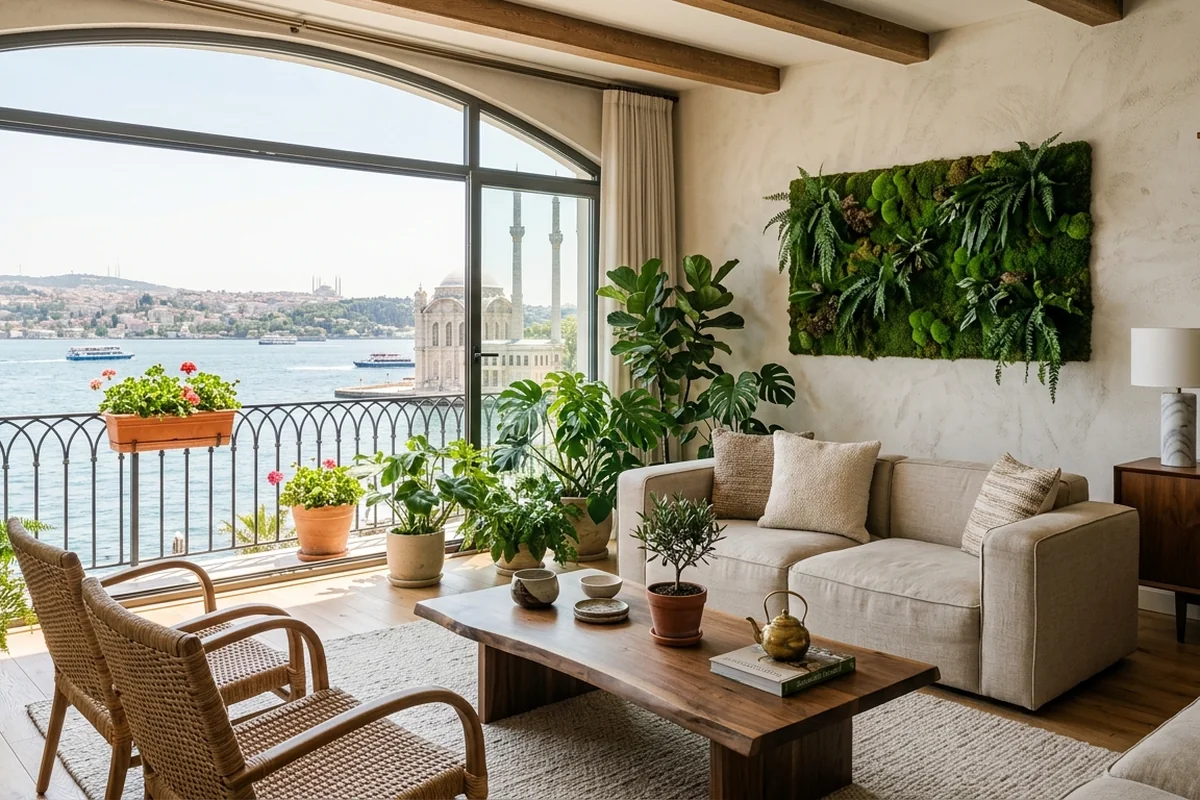
- **Biophilic design integration:** Bring nature indoors through living walls, natural light maximization, indoor plants, and organic material palettes. Research from Harvard Health Publishing confirms that biophilic environments measurably reduce stress and improve cognitive performance.
- **High-performance insulation and glazing:** Specify triple-glazed windows and continuous insulation layers to reduce heating and cooling loads. This is especially critical in Istanbul where summers are hot and winters are damp.
- **Low-VOC and non-toxic finishes:** Select paints, adhesives, and sealants that emit minimal volatile organic compounds. Indoor air quality directly affects occupant health and wellbeing.
- **Water-efficient fixtures:** Install low-flow faucets, dual-flush toilets, and greywater recycling systems. In a city under increasing water stress, this is both responsible and regulation-forward.
- **Renewable energy readiness:** Design electrical systems that accommodate solar PV panels and battery storage from day one, even if installation is phased.
- **Circular economy sourcing:** Prioritize reclaimed timber, recycled stone, and locally quarried marble to reduce embodied carbon and support Istanbul’s artisan economy.
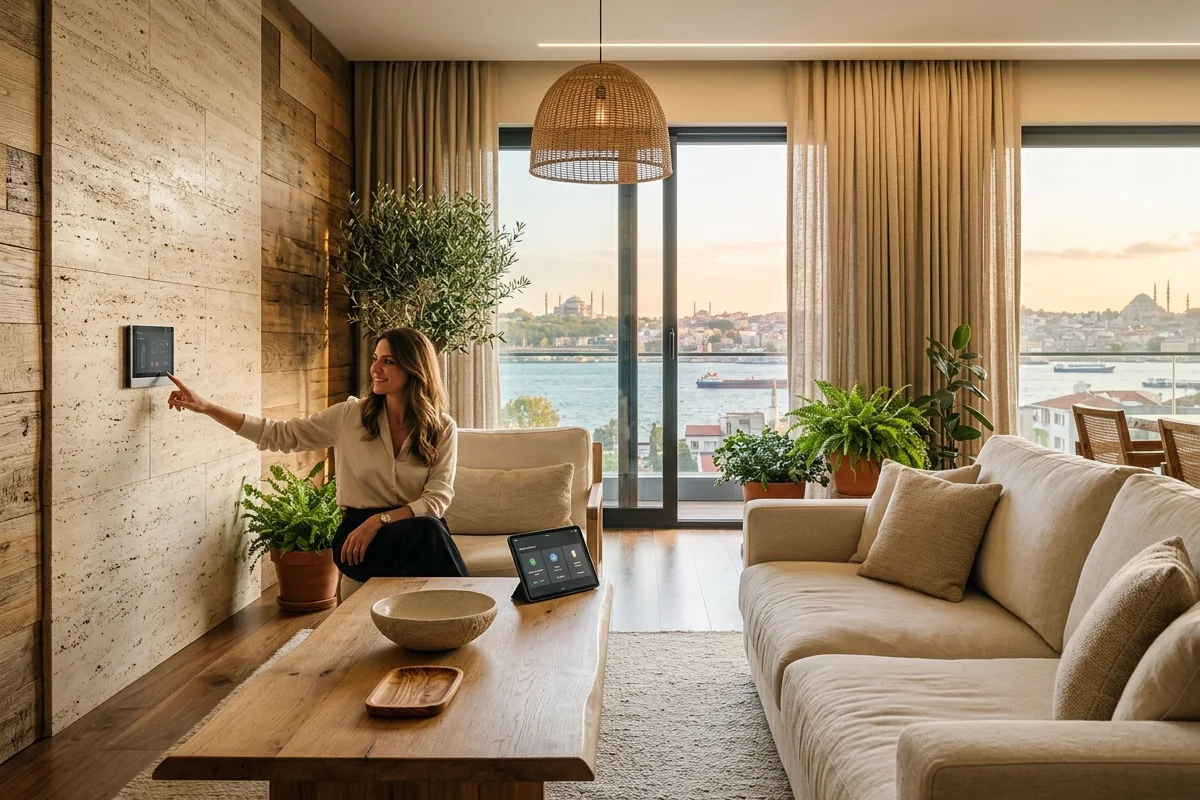
- **Smart building technology:** Integrate occupancy sensors, automated shading, and energy monitoring dashboards so residents and facility managers can optimize consumption in real time.
Each of these principles compounds the others. A well-insulated envelope reduces HVAC demand; smart controls optimize what remains. The result is a space that performs beautifully on every level — thermal, acoustic, visual, and environmental.
The U.S. Green Building Council’s LEED certification framework provides an internationally recognized scoring system that aligns directly with these seven principles. Targeting LEED Silver or Gold on an Istanbul project signals quality to investors and tenants alike, and it increasingly influences asset valuation.
Materials, certifications, and smart sourcing in Istanbul
Istanbul offers remarkable access to premium natural materials — Marmara marble, Anatolian oak, handcrafted ceramic tiles, and artisan metalwork. Smart sourcing means leveraging these regional assets while applying rigorous environmental criteria to every specification.
When we select materials for a project, we evaluate them across three dimensions: embodied carbon (how much CO₂ was emitted to produce and transport the material), indoor air quality impact (does it off-gas harmful chemicals?), and end-of-life recyclability (can it be recovered and reused?). This triple filter ensures that luxury finishes deliver genuine sustainability credentials, not just marketing claims.
Certifications matter enormously in this space. Look for materials that carry FSC certification for timber, Cradle to Cradle certification for manufactured products, and EPD (Environmental Product Declaration) documentation for stone and concrete. The BREEAM certification scheme, widely used across European and Middle Eastern markets, provides a rigorous framework for assessing building sustainability that many Istanbul developers are now adopting for commercial and mixed-use projects.
Local procurement is another powerful lever. Sourcing Marmara marble from quarries within 300 kilometers of Istanbul rather than importing Italian stone cuts transport emissions dramatically. It also supports regional craftspeople and creates a distinctive sense of place — a quality that luxury clients consistently prize.
For villa and residential projects, our villa architectural design work in Istanbul demonstrates how locally sourced materials can be combined with contemporary detailing to create interiors that feel both timeless and deeply rooted in their context. Pair this with smart project delivery through turnkey project execution in Istanbul and you eliminate the coordination gaps that often undermine sustainability goals on complex builds.
Comparing green design approaches: A practical overview
Not every eco-friendly strategy suits every project type. The table below compares the most common approaches across three key project categories — residential villas, commercial offices, and boutique hospitality — to help you prioritize investment.
| Design Strategy | Residential Villa | Commercial Office | Boutique Hotel |
|---|---|---|---|
| Biophilic elements (living walls, natural light) | High impact, high ROI | High impact, productivity gains | High impact, guest experience driver |
| Solar PV + battery storage | Excellent fit, long payback | Good fit, energy cost reduction | Moderate fit, depends on roof area |
| Greywater recycling | Very suitable, significant savings | Suitable for large footprints | Highly suitable, operational savings |
| Low-VOC finishes | Essential for family health | Essential for occupant wellbeing | Essential for guest comfort |
| Smart energy management | Moderate complexity, strong ROI | High complexity, strong ROI | High complexity, brand differentiator |
| Reclaimed/local materials | Strong aesthetic and ethical value | Moderate use, feature elements | Very strong — authenticity premium |
| LEED / BREEAM certification | Optional but valuable for resale | Often required by tenants | Strong marketing asset |
This comparison makes clear that certain strategies — low-VOC finishes, biophilic elements, and local materials — deliver value across every project type. Others, like solar PV and greywater systems, require project-specific feasibility analysis.
The ArchDaily sustainable architecture resource hub provides an excellent ongoing reference for case studies, material innovations, and design strategies from leading studios worldwide. Staying current with global best practice is essential when advising clients on emerging technologies like phase-change materials, aerogel insulation, and electrochromic glazing — all of which are beginning to appear in Istanbul’s premium market.
Commercial projects in Istanbul benefit enormously from a sustainability-first approach. Our work on commercial architecture in Istanbul shows how green credentials translate directly into tenant attraction, lease premium, and ESG compliance for corporate occupiers. The market has shifted: sustainability is no longer a differentiator — it is rapidly becoming a baseline expectation.
Practical tips for implementing eco-friendly luxury design in Istanbul
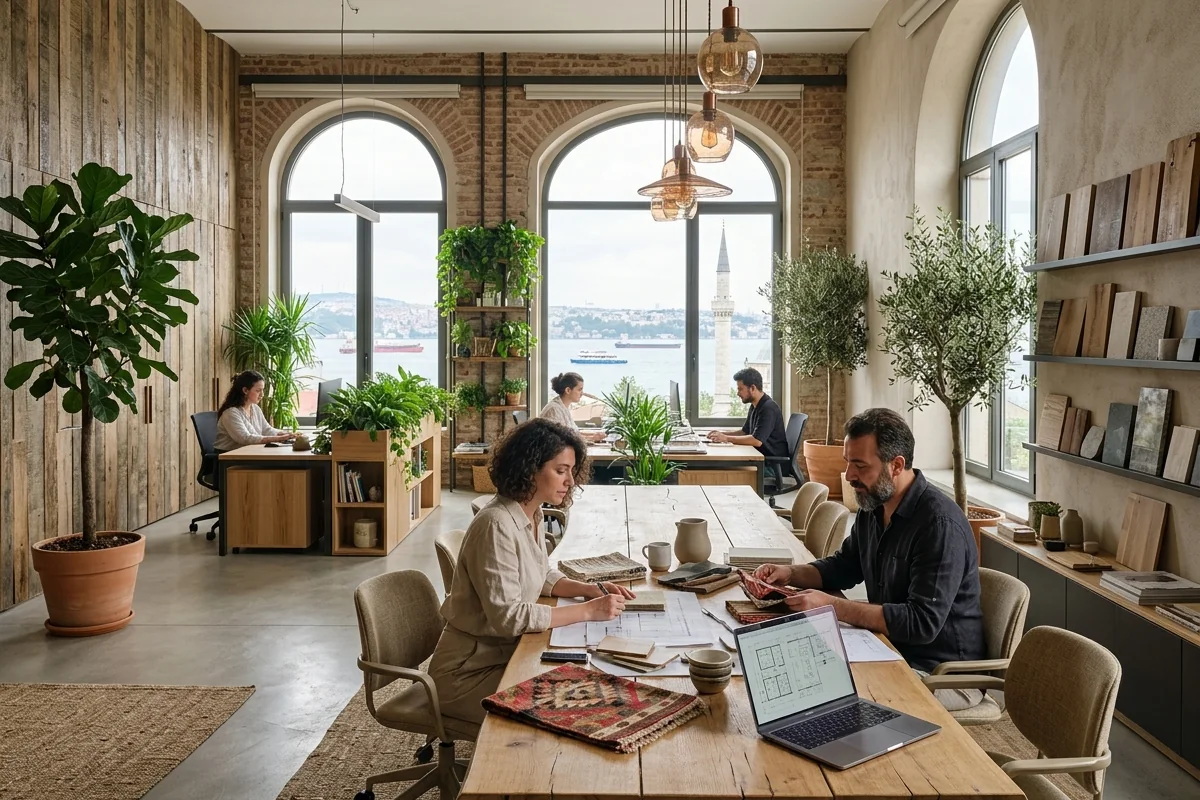
Moving from principle to practice requires a structured process. Here is how we recommend approaching an eco-friendly luxury interior project in Istanbul:
- **Start with an environmental brief:** Before any design work begins, define energy targets, material exclusion lists, and certification goals. This brief governs every subsequent decision.
- **Engage a sustainability consultant early:** Bring in a specialist during concept design, not at the end. Early-stage input costs a fraction of late-stage redesign.
- **Audit existing conditions:** For renovation projects, assess the existing building envelope, MEP systems, and hazardous materials before specifying anything new. This avoids costly surprises and identifies quick wins.
- **Design for adaptability:** Build in flexibility so spaces can evolve without demolition. Demountable partitions, modular joinery, and accessible service routes extend the useful life of the interior.
- **Document everything:** Maintain a full material passport for the project — a record of every product, its origin, and its environmental credentials. This documentation supports future certification applications and resale due diligence.
- **Educate your client:** The most sustainable building is one whose occupants understand how to use it. Provide a simple operations guide covering smart system controls, maintenance schedules, and recycling protocols.
Understanding the full project lifecycle is equally important. Our detailed guide on steps in project planning and execution walks through every phase from brief to handover, ensuring that sustainability commitments made at concept stage are actually delivered on site.
If you are ready to begin your eco-friendly luxury interior project in Istanbul, we invite you to contact our studio for an initial consultation. We combine deep local knowledge with international sustainability expertise to deliver spaces that are genuinely exceptional — for you, and for the city.
—
Frequently Asked Questions
Q1: Does eco-friendly interior design cost more than conventional design in Istanbul?
Upfront costs for sustainable materials and systems can run 10–20% higher than conventional equivalents, but lifecycle savings on energy, water, and maintenance typically recover that premium within five to eight years. Premium sustainable interiors also command higher resale and rental values in Istanbul’s competitive property market, making the investment financially sound as well as ethically responsible.
Q2: Which green certification is most recognized for luxury properties in Istanbul?
LEED (Leadership in Energy and Environmental Design) and BREEAM are both well recognized by international investors and corporate tenants operating in Istanbul. LEED tends to dominate in residential and mixed-use luxury projects, while BREEAM is frequently specified for commercial and hospitality assets targeting European institutional investors. Your design team can advise on which framework best aligns with your project goals and target market.
Q3: Can a historic Istanbul property be redesigned to meet modern sustainability standards?
Yes — and some of the most compelling sustainable luxury projects in Istanbul involve the adaptive reuse of historic structures. Older buildings often have thick masonry walls with excellent thermal mass, high ceilings that support natural ventilation, and original materials with very low embodied carbon. The key is to layer contemporary high-performance systems — upgraded glazing, efficient HVAC, smart controls — onto the existing fabric without compromising heritage value. Our team has extensive experience navigating Istanbul’s conservation regulations while delivering outstanding environmental performance.
Q4: How do I choose the right studio for a sustainable luxury interior project in Istanbul?
Look for a studio with a demonstrable track record in both luxury design and sustainability — not just one or the other. Ask to see completed projects with verified energy performance data, material certifications, and client testimonials. Review their project portfolio and ask specifically about their sustainability process. A studio that integrates environmental thinking from day one — rather than treating it as an add-on — will consistently deliver better outcomes. You can also read our guide on how to choose an architectural design firm for a comprehensive checklist.

Related Posts
Client success stories in high-end interior design: 7 Proven Wins
Explore 7 client success stories in high-end interior design and discover how…

Outdoor living spaces for Istanbul’s climate: 7 Expert Design Tips
Discover 7 expert tips for designing outdoor living spaces for Istanbul's…
Smart home technology for luxury interiors: 10 Expert Tips
Discover how smart home technology for luxury interiors elevates comfort,…